Research Portfolio — Alexandre Lemière

Peg Failure & Tracking Error in DeFi Synthetic Assets

Twenty audited data pipelines and technical reports covering every major DeFi peg-design family, applying econometrics, machine learning, reinforcement learning and graph theory to one question: how, and why, do synthetic assets lose their peg — and what does that imply for designing one that doesn't.

~20
protocols covered
77 GiB
audited on-chain data
3
historical collapses replayed
1
headline result retracted after audit

Selected findings

“The 25-delta skew leads BTC/ETH stress by 3–4 days” was the exciting early result. An adversarial second audit found the lead-time statistic was bounded by construction — even the random baseline reports a 4.0-day lead — and a circular-shift permutation test failed to reject no anticipation (p = 0.186 BTC, 0.098 ETH). The claim was retracted.
The same evaluation standard was applied to every other result in the corpus — including the ones that survived it. See the Internship Report, §5.2, and the IV-smirk gate report below.
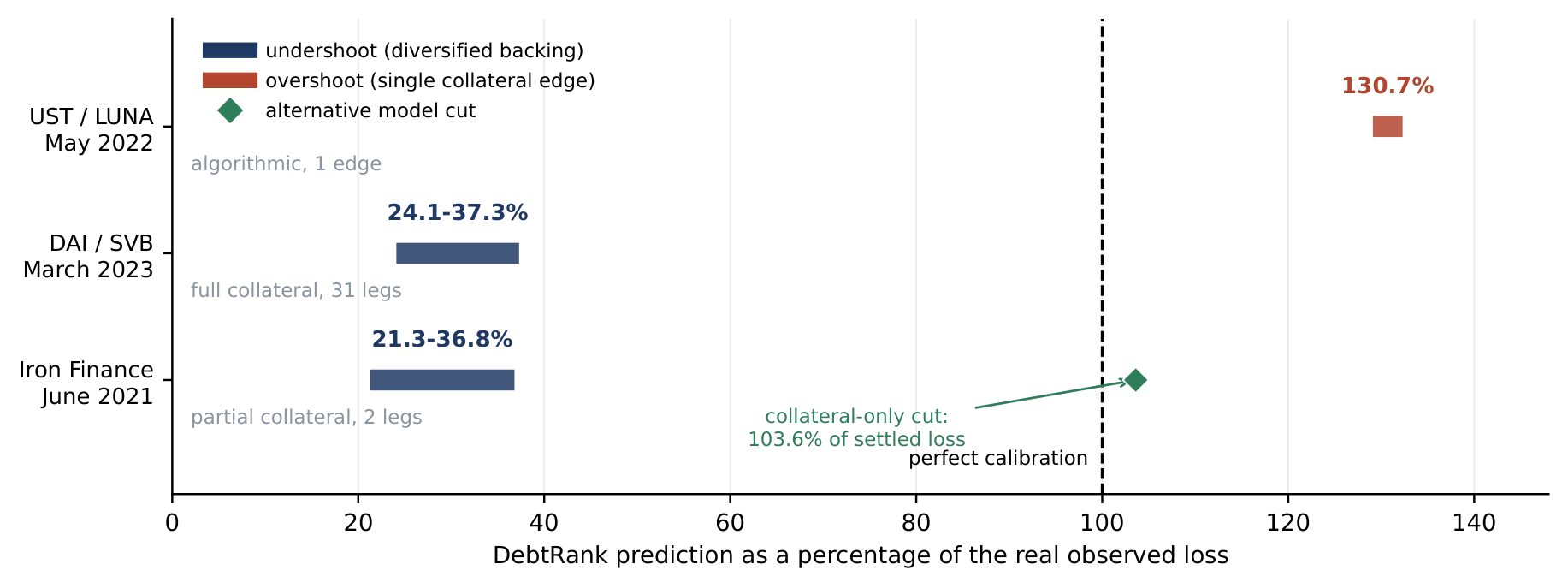
DebtRank prediction vs real observed loss for three historical collapses: DAI/SVB, UST/Terra, Iron Finance
A systemic-risk model, tested against reality before being trusted. Three DebtRank replays, each built the evening before its real collapse and calibrated to the actual shock. Diversified and partial collateral structures both undershoot the real loss by roughly 3–4×; a single undiversified collateral edge (UST) overshoots by 1.3× — a pattern that's predictable even though the exact size isn't. Full report ↗
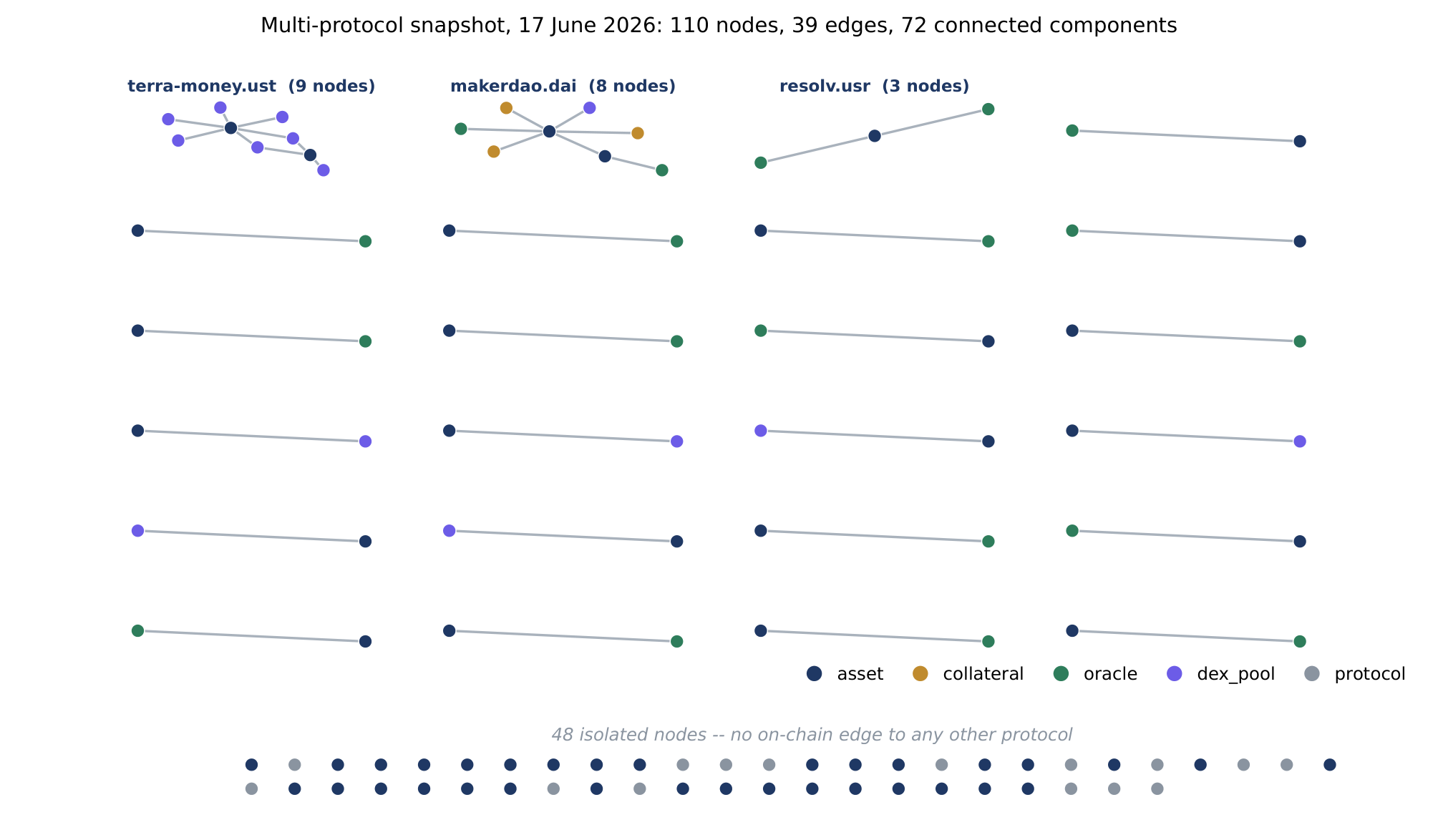
Multi-protocol on-chain dependency graph: 110 nodes, 39 edges, 72 connected components
The systemic-risk question the data can't yet answer. Auto-discovered across every tracked asset with real edge data on disk, the full multi-protocol dependency graph is 110 nodes and only 39 edges, splitting into 72 connected components — 48 of them fully isolated. "Do central protocols suffer more?" is not a null result here; the network the question presupposes barely exists on-chain. Full report ↗

Index of reports

Full collateral (CDP-backed)

MakerDAO — DAI

Survived the March 2020 liquidation cascade and the March 2023 SVB contagion. During SVB the Chainlink DAI/USD oracle bottomed at $0.889 while DAI traded down to $0.828 on Curve — a 600+ bp dislocation invisible to a single-oracle circuit breaker. One layer up, USDC's oracle floor of $0.88 sat 697 bp above its $0.810 exchange wick.

Liquity — LUSD

Structurally premium-biased peg; the $1 redemption floor binds hard, with redemption intensity 7–8× higher below par than above.

Curve — crvUSD

PegKeeper-defended, slightly sub-peg by design. Egorov's insulation architecture holds up empirically: stress routes into the LLAMMA soft-liquidation mechanism, not into the peg itself.

Partial / algorithmic collateral

Iron Finance — IRON/TITAN

Full forensic reconstruction of the June 2021 collapse: TITAN's supply inflated ~335,000× in ~24 hours. Only 1 of 8 pre-registered early-warning signals carried real information.

FRAX — V1

The survivor half of the Iron Finance comparison: near-identical contract logic, but FRAX raised its collateral ratio +8pp under stress while Iron let it fall −25.7pp — and only one protocol is still alive.

Terra — UST

Full reconstruction of the May 2022 collapse of the (then) third-largest stablecoin. A DebtRank systemic-risk replay overshoots the real loss by 1.3× — the model has no mechanism for the Luna Foundation Guard's reserve defense.

Mirror Protocol

34 synthetic assets (mAssets) on Terra. The Band oracle freeze that silently broke tracking is empirically dated; tracking error is shown to be undefined after 2022-06-01, not zero.

Shared debt pool (Synthetix)

sUSD

The base synth of the pool: a soft structural sub-peg (~−0.4% baseline) turned into an acute, still-open depeg starting May 2024 — daily-median trough of $0.593 reached February 2026.

Crypto cohort (sETH, sBTC, sLINK…)

Oracle fidelity is essentially perfect across 6 years — the apparent "depeg" is DEX-venue liquidity decay setting in from 2024, not an oracle failure.

Equity cohort (sTSLA, sAAPL…)

One flagship offset (sGOOG) is correctly re-attributed from an assumed dividend effect to a genuine, measurable Chainlink feed low-bias.

Commodity / index cohort (sXAU, sXAG, sFTSE, sNIKKEI)

The Wezen-release redemption freeze is dated precisely via a difference-in-differences design.

Inverse cohort (iETH, iBTC…)

Tracking error is the wrong lens here — price is a deterministic clamped formula. The real story: 1,161 clamp episodes and a 2020–2021 freeze cascade (29 events) as the bull run pinned every inverse synth to its floor.

Fiat-backed (centralized)

Circle — USDC

Reference stablecoin; full forensic reconstruction of the March 2023 SVB depeg, used as the calibration case for the whole corpus.

Tether — USDT

Peg fidelity is high in the center but sharply heavy-tailed. The real-time stress signal is the Curve 3pool weight imbalance, not the (opaque, off-chain-backed) oracle.

Liquid staking, index & delta-neutral

Lido — stETH

Reconstructed through the June 2022 Celsius/3AC contagion; the withdrawal queue's latency is priced — each extra day of queue costs −1.28bp of discount.

GMX — GLP

A NAV-tracking, perpetuals-linked liquidity index. Trading fees couldn't offset basket drawdown; GMX V1 wound down −99.8%.

Ethena — USDe / sUSDe

2024 launch through the October 2025 Binance oracle-bug case study; a mis-measured "peg improvement" claim is corrected to a real median bias of −4.45bp.

Resolv — USR

The March 2026 depeg is forensically identified as an AWS-key/opsec breach (~80M unbacked USR illicitly minted) — explicitly not a failure of the delta-neutral hedge design.

Vertex Protocol — perps

Top-3 perpetual markets; tracking error measured against the perp-mid reference rather than a single spot oracle.

Backed Finance — xStocks

Physically-backed tokenized equities track ~9× tighter than the now-dead synthetic equivalent (0.66% vs 5.8% RMSE) — and survived where the synthetic died at a 2021 freeze event.

Cross-cutting syntheses

Implied-volatility smirk gate (S8)

The 25-delta BTC/ETH skew carries statistically significant incremental information about stress beyond a DVOL-style index — but an initial claim that it anticipates stress days in advance was retracted after an adversarial self-audit found it was an artifact of a bounded search window.

Systemic-risk graph theory (S9)

A from-scratch DebtRank contagion model, validated against three real historical collapses before being run at scale. The real cross-protocol dependency graph turns out to be a mostly-disconnected forest — 72 connected components across 110 nodes.